
MDF vs Particle Board: 7 Key Differences for Furniture Buyers
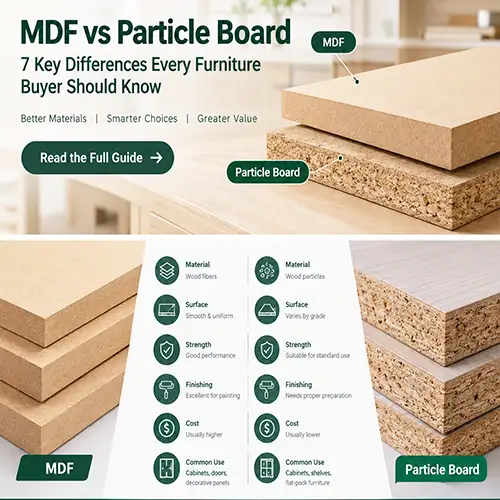
When sourcing materials for furniture manufacturing, cabinetry or commercial interior projects, choosing between MDF and particle board can affect product quality, production efficiency and overall cost. Both are widely used engineered wood panels, but they are not interchangeable. MDF is made from fine wood fibers, while particle board is manufactured from wood particles bonded with resin. These different structures influence surface finish, machining, fastener performance and price. Fortuna supplies both furniture MDF and furniture particle board for international furniture factories, wholesalers and project buyers. The short answer: Choose MDF for smooth painted surfaces, shaped furniture components and detailed machining. Choose particle board for cost-efficient cabinet carcasses, melamine-faced furniture and high-volume production where the panel specification meets the application’s requirements. This guide compares MDF vs particle board to help importers, furniture manufacturers and building-material distributors make a more informed purchasing decision. 1. MDF vs Particle Board: Quick Comparison Feature MDF Particle Board Raw material Fine wood fibers Wood particles and chips Surface Smooth and uniform Depends on grade and surface treatment Density Generally higher Varies by grade and construction Strength Good for many furniture applications Suitable for properly designed furniture components Painting Excellent smooth substrate Usually needs suitable surface preparation CNC machining Excellent for many profiles and shapes Suitable for many standard cutting operations Screw holding Depends on panel density and fastening position Depends on density, edge distance and fastener type Moisture resistance Standard MDF is moisture-sensitive Standard particle board is moisture-sensitive Typical cost Usually higher Usually lower Common applications Painted doors, decorative panels, moldings Cabinet carcasses, shelves and flat-pack furniture Actual performance depends on panel grade, density, thickness, adhesive system, surface finish and manufacturing quality. Neither material is automatically suitable for every load-bearing or moisture-exposed application. 2. What Is MDF Board? MDF stands for Medium-Density Fibreboard. It is produced by breaking wood into fine fibers, combining them with adhesive and other additives, and pressing the mixture into uniform panels under heat and pressure. Because its fibers are distributed relatively evenly, MDF provides a smooth surface and consistent structure that suit many furniture manufacturing processes. Main Advantages of MDF Smooth surface: Suitable for painting, laminating and decorative finishes. Consistent structure: No natural wood grain or large veneer knots to interrupt the surface. Flexible machining: Can be cut, routed and profiled for decorative designs. Suitable for furniture finishing: Works well for cabinet doors, wall panels and shaped components. Multiple product options: Standard MDF and moisture-resistant grades can be specified for different applications. Common Applications MDF is frequently selected for painted cabinet doors, wardrobe panels, decorative moldings, office furniture, wall cladding and interior design components. For manufacturers producing furniture with detailed profiles or a uniform painted finish, MDF is often the more practical option. However, standard MDF can swell when exposed to water. Moisture-resistant MDF may improve performance in humid environments, but it should not automatically be treated as waterproof. 3. What Is Particle Board? Particle board, also known as chipboard in many markets, is manufactured from wood particles bonded together with resin and pressed into panels. Its relatively economical production makes it a popular material for furniture manufacturers seeking competitive costs across large production runs. Main Advantages of Particle Board Competitive material cost: Often the more economical option for furniture panels. Efficient mass production: Suitable for standardized furniture components. Melamine surface options: Can be supplied with decorative finishes in a wide range of colors and patterns. Practical for cabinet construction: Commonly used for concealed cabinet structures and shelving. Available in different specifications: Panel thickness, surface finish and emission requirements can be selected for the intended market. Common Applications Particle board is widely used for wardrobe carcasses, kitchen cabinet structures, office desks, bookcases, storage furniture and flat-pack furniture. Melamine-faced particle board is particularly useful when manufacturers need a ready-to-use decorative surface without painting every component separately. Its limitations should also be considered. Particle board may chip during machining, and damaged or exposed edges can absorb moisture. Appropriate edge banding, hardware selection and installation practices help improve service life. 4. Which Is Stronger: MDF or Particle Board? MDF generally offers a more uniform structure and is often preferred for shaped components and applications requiring consistent machining. However, it is not accurate to assume that every MDF panel is stronger than every particle board panel. Performance depends on the type of load, panel thickness, density, internal bonding and manufacturing quality. For example: Cabinet doors: MDF is often preferred when routing or painting is required. Cabinet carcasses: Particle board can provide an economical solution when correctly specified. Long shelves: Both materials require appropriate thickness and support spacing to control sagging. Hardware installation: Screw type, pilot holes, edge distance and repeated loading can matter as much as the panel type. For bulk purchasing, request technical data for bending strength, internal bond, screw withdrawal and thickness tolerance where these properties are important to your application. Do not select a panel solely because its product name suggests superior strength. 5. Which Board Is Better for Furniture? The right choice depends on the finished product and manufacturing process. Furniture Application Recommended Option Reason Painted cabinet doors MDF Smooth surface and profile machining Decorative wall panels MDF Suitable for shaped and painted designs Melamine wardrobe carcasses Particle board Cost-efficient decorative panel construction Flat-pack furniture Particle board or MDF Depends on design, finish and budget Routed decorative fronts MDF Suitable for detailed machining High-volume economical shelving Particle board or MDF Depends on span, load and thickness Humid interior applications Suitable moisture-resistant grade Confirm actual performance requirements These are starting points, not universal rules. A well-designed product also requires suitable hardware, edge protection and installation details. 6. MDF vs Particle Board: Which Is Better for Moisture Resistance? Neither standard MDF nor standard particle board should be assumed to withstand prolonged water exposure. Both materials can absorb moisture through exposed edges, damaged surfaces and poorly sealed openings. Swelling can reduce dimensional accuracy and damage the panel. For kitchens, bathrooms and other humid interior environments, buyers should consider: Moisture-resistant panel grades where appropriate Sealed