18mm Film Faced Plywood: Specifications, Uses & Buying Guide
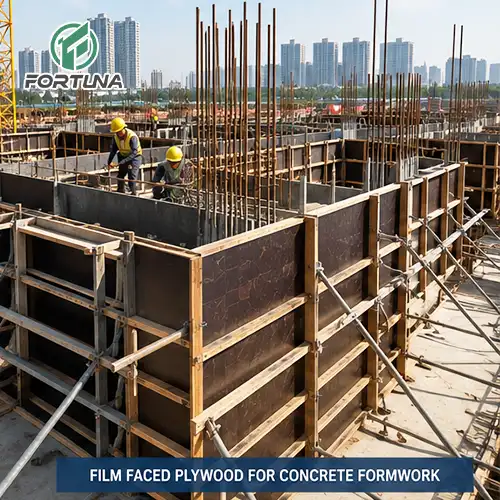
18mm film faced plywood is widely used for concrete formwork, shuttering systems, and construction projects. Its combination of structural support, moisture-resistant surface protection, and potential for repeated use makes it a common choice for contractors and building material distributors.
However, not all 18mm film faced plywood offers the same performance. Core materials, adhesive quality, film coating, and manufacturing processes can significantly affect durability, concrete surface finish, and overall project costs.
This guide explains the key specifications, applications, and purchasing considerations for importers, wholesalers, and construction project buyers.
What Is 18mm Film Faced Plywood?
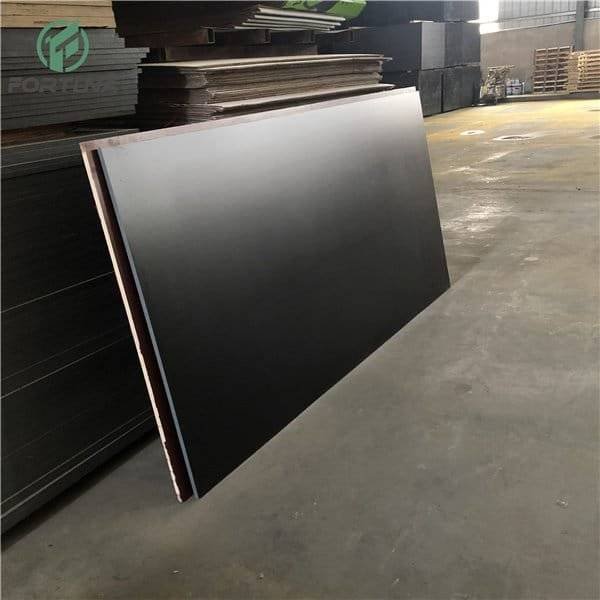
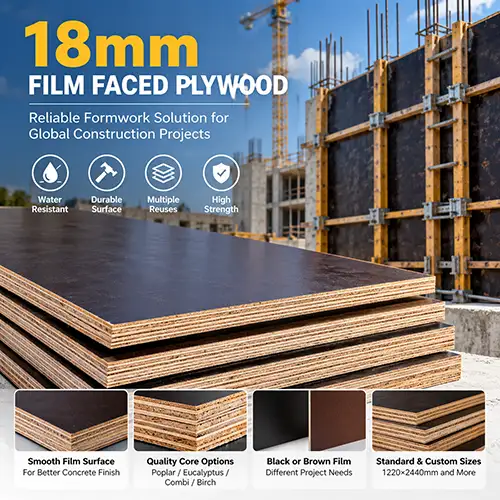
18mm film faced plywood is an engineered wood panel manufactured from multiple veneer layers bonded together and covered with a protective resin-impregnated film.
The film helps reduce moisture penetration and provides a relatively smooth surface for concrete casting. Depending on the market, the product is also called 18mm shuttering plywood, phenolic plywood, or concrete formwork plywood.
Unlike ordinary commercial plywood, film faced plywood is designed primarily for temporary construction formwork applications.
Its performance depends on the complete panel construction, not simply its nominal thickness or surface color.
18mm Film Faced Plywood Specifications
The following specifications reflect the product options listed by Fortuna Wood. Actual values should be confirmed against the selected grade and order requirements.
| Specification | Available Options |
|---|---|
| Product | Film Faced Plywood |
| Nominal Thickness | 18mm |
| Standard Sheet Size | 1220 × 2440mm (4 × 8 ft) |
| Other Sizes | 900 × 2100mm, 1250 × 2500mm |
| Thickness Tolerance | ±0.5mm |
| Core Material | Poplar, Eucalyptus, Combi, Birch |
| Surface Film | Black, Brown, Dark Brown, Anti-Slip |
| Adhesive Options | Phenolic, WBP-designated, MR |
| Manufacturing Options | One-Time or Two-Time Hot Press |
| Listed Density Range | 500–700 kg/m³ |
| Listed Moisture Content | 8–14% |
| Customization | Size, Core, Film, Thickness |
Important: WBP describes a water-boil-resistant bonding performance category rather than a single adhesive chemistry. MR-bonded panels should not automatically be treated as suitable for prolonged wet formwork conditions. Buyers should request the relevant bond-test results.
For international projects, confirm whether the plywood complies with the required product and bonding standards before ordering.
Why Is 18mm Plywood Commonly Used for Concrete Formwork?
18mm is a frequently specified thickness because it can provide a practical balance between panel rigidity, handling requirements, and material cost.
However, thickness alone does not determine the panel’s load-bearing capacity.
The following factors also influence formwork performance:
Veneer species and core construction
Number and quality of veneer layers
Bonding strength and adhesive performance
Spacing between formwork supports
Concrete pressure and construction loads
Panel condition after repeated use
For high-load concrete applications, contractors should verify bending strength, stiffness, and allowable support spacing using appropriate engineering calculations and tested panel data.
Main Applications
1. Concrete Wall Formwork
Film faced plywood is used as a facing material in temporary formwork systems for concrete walls and vertical structures.
2. Slab and Floor Formwork
18mm panels can be used in supported slab formwork systems where their verified structural properties meet the project design requirements.
3. Columns and Beams
Panels can be cut and assembled into formwork components for columns, beams, and other concrete elements.
4. Commercial and Infrastructure Projects
Construction contractors use film faced plywood in residential developments, commercial buildings, and selected infrastructure projects.
The appropriate grade and support system should always be selected according to the project’s loading conditions.
Poplar, Eucalyptus, Combi or Birch Core: Which Is Better?
Core selection is one of the most important decisions when sourcing 18mm concrete formwork plywood.
| Core Type | Main Characteristics | Typical Buying Considerations |
|---|---|---|
| Poplar | Relatively lightweight; economical options available | Cost-sensitive projects with verified performance requirements |
| Eucalyptus | Generally denser hardwood construction | Applications requiring suitable stiffness and strength |
| Combi | Combines different veneer species | Balance of cost, weight, and performance |
| Birch | Dense, uniform veneers in well-manufactured panels | Higher-specification applications where tested properties justify the cost |
A hardwood core does not automatically guarantee better performance. Veneer quality, glue bonding, core gaps, and production consistency can be equally important.
For large orders, buyers should request representative samples and compare physical test results rather than relying only on the stated core species.
Black vs Brown Film Faced Plywood
Black and brown film faced plywood are commonly supplied for construction formwork.
Both can be suitable for concrete casting when manufactured with appropriate film, adhesive, and core materials.
Black Film Faced Plywood
Commonly specified for construction formwork
Available with different core and adhesive combinations
Performance varies according to panel construction
Brown Film Faced Plywood
Available with resin-impregnated surface films
Often selected for concrete surface finish requirements
Film weight and bonding quality vary between grades
Which should buyers choose?
Film color alone is not a reliable indicator of durability or reuse performance.
Instead, compare film weight, abrasion resistance, surface bonding, core quality, and moisture exposure performance.
How Many Times Can 18mm Film Faced Plywood Be Reused?
The number of possible reuses depends on manufacturing quality, construction conditions, and handling practices.
There is no universal reuse figure applicable to every 18mm film faced plywood panel.
Factors affecting reuse include:
Core integrity: Core gaps, delamination, and veneer defects can shorten service life.
Adhesive bonding: Poor bonding can cause separation under repeated moisture exposure.
Film durability: Surface damage increases moisture penetration and concrete adhesion.
Edge protection: Unsealed or damaged edges are particularly vulnerable to water.
Site handling: Rough stripping, improper storage, and mechanical damage reduce reuse potential.
To extend service life, contractors should clean panels after use, apply suitable release agents, protect cut edges, and store sheets flat in dry, ventilated conditions.
For procurement comparisons, evaluate cost per successful use rather than purchasing price alone.
How to Inspect 18mm Film Faced Plywood Before Bulk Orders
For importers and wholesale distributors, product consistency is often more important than the appearance of a single sample.
Before confirming a shipment, consider the following checks.
1. Thickness and Dimensions
Measure multiple sheets and verify thickness tolerance, panel squareness, and dimensional consistency.
2. Core Construction
Inspect representative cut edges for overlapping veneers, excessive gaps, voids, and poorly bonded layers.
3. Surface Film
Check film adhesion, surface uniformity, scratches, and visible defects.
4. Moisture and Bonding
Request moisture-content measurements and relevant adhesive bond-test documentation.
5. Mechanical Properties
Where structural performance is required, obtain verified bending strength and modulus of elasticity data.
6. Packaging and Shipping
Confirm pallet protection, edge guards, sheet counts, container loading, and moisture protection during transportation.
These checks help reduce the risk of inconsistent deliveries and unexpected material losses on construction sites.
What Affects 18mm Film Faced Plywood Prices?
The wholesale price of 18mm film faced plywood depends on several factors:
Core species and veneer quality
Adhesive and bonding requirements
Film specification and surface treatment
Manufacturing process and quality grade
Sheet dimensions and thickness tolerance
Order quantity and packaging
Shipping destination and trade terms
A lower initial quotation does not necessarily mean a lower project cost.
For example, a panel with a higher purchase price may offer better value if its verified performance supports more successful uses and fewer replacements.
When comparing suppliers, request quotations based on identical technical specifications and Incoterms.
How to Choose a Reliable Film Faced Plywood Supplier
A suitable film faced plywood supplier should provide more than competitive pricing.
International buyers should assess:
Product Specifications: Are core materials, adhesives, dimensions, and film requirements clearly documented?
Quality Consistency: Can the supplier provide representative samples and relevant inspection records?
Bulk Supply Capability: Can the supplier meet agreed order volumes, production schedules, and packaging requirements?
Export Documentation: Are commercial invoices, packing lists, and destination-specific compliance documents available?
Technical Communication: Can the supplier explain material differences and confirm the selected product’s intended application?
For long-term sourcing, consistent specifications and reliable documentation are essential.
Source 18mm Film Faced Plywood from Fortuna Wood
Fortuna Wood supplies film faced plywood options for construction material buyers, including 18mm panels with different core materials, surface films, and sheet dimensions.
Available product configurations include poplar, eucalyptus, combi, and birch cores, with black and brown film options.
Importers, wholesalers, and project contractors can review the available specifications and discuss order-specific requirements.
Explore Fortuna Wood’s 18mm Film Faced Plywood
For bulk procurement, provide your preferred sheet size, core material, adhesive specification, surface film, estimated quantity, and destination market.
FAQs
1. Is 18mm film faced plywood waterproof?
The film provides moisture resistance, but the entire panel is not necessarily waterproof. Performance depends on adhesive bonding, edge sealing, core construction, and exposure conditions.
2. What is the standard size of 18mm shuttering plywood?
A common size is 1220 × 2440mm (4 × 8 ft). Other sizes, including 1250 × 2500mm, may be available depending on the supplier.
3. Which core is best for 18mm film faced plywood?
The best core depends on loading requirements, handling preferences, project budget, and tested panel performance. Poplar, eucalyptus, combi, and birch are common options.
4. Can 18mm film faced plywood be reused?
Yes. Reuse depends on panel quality, concrete casting conditions, stripping methods, and maintenance. Buyers should not assume a fixed reuse count without supporting evidence.
5. Can MDF or particle board be used outdoors?
Standard MDF and particle board are generally intended for interior applications. Outdoor use requires a material specifically designed and tested for the exposure conditions; a decorative surface alone does not make a panel weatherproof.
6. What should buyers confirm before ordering wholesale film faced plywood?
Confirm sheet dimensions, thickness tolerance, core type, adhesive performance, film specification, inspection requirements, order quantity, and delivery terms.
Conclusion
18mm film faced plywood remains an important material for concrete formwork and construction projects. However, selecting the right panel requires more than comparing thickness and price.
Core quality, bonding strength, film durability, dimensional accuracy, and supplier consistency all influence purchasing value.
For importers, wholesalers, and construction contractors, clear specifications and documented quality requirements are the foundation of reliable bulk procurement.
Related Articles
- All Posts
- Company News
- Product Post
18mm Film Faced Plywood: Specifications, Uses & Buying Guide 18mm film faced plywood is widely used for concrete formwork, shuttering systems, and construction projects. Its combination of structural support, moisture-resistant surface protection, and potential for repeated use makes it a common choice for contractors and building material distributors. However, not...
Film Faced Plywood vs Marine Plywood: What’s the Difference? When sourcing plywood for construction, infrastructure, marine engineering, or commercial projects, buyers often ask one important question: Should I choose Film Faced Plywood or Marine Plywood? Although both products are manufactured from high-quality veneers and waterproof adhesives, they are designed for...