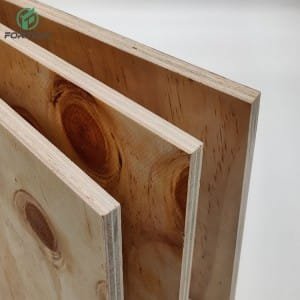
What Is CDX Pine Plywood?
CDX Pine Plywood is a construction-oriented plywood panel typically identified by a C-grade face, D-grade back, and an Exposure 1-type adhesive classification. It is commonly used for structural applications such as roof sheathing, wall sheathing, subflooring, packaging, and other construction panels where appearance is less important than strength and functionality.
For international buyers, however, there is an important detail: “CDX” alone is not a complete technical specification.
The actual requirements should include the panel thickness or Performance Category, structural rating, span rating where applicable, bond classification, dimensions, veneer/core construction, and the applicable market standard.
APA notes that “CDX” is commonly used in the trade for Exposure 1 plywood, but it should not be treated as equivalent to a panel rated for long-term exterior exposure.
That distinction matters when you are purchasing several containers for a construction project.
What Does CDX Mean?
The three letters are the easiest way to understand the basic concept.
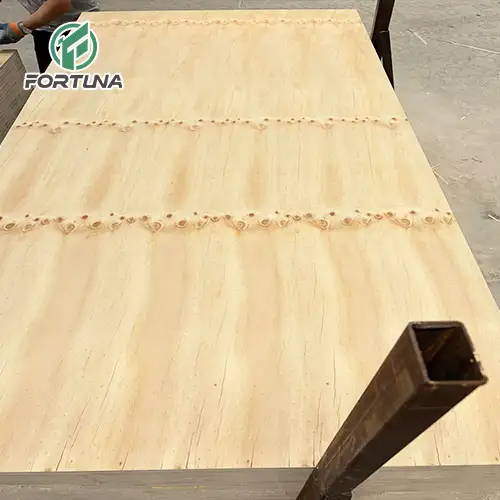
C = C-Grade Face
The C refers to the veneer grade on one face.
It is a utility-oriented appearance grade. You can expect visible natural characteristics and repairs that would not be acceptable on higher appearance-grade plywood.
That is not necessarily a disadvantage.
For structural applications, buyers are usually paying for performance rather than furniture-grade appearance.
D = D-Grade Back
The D indicates a lower appearance grade on the opposite face.
This side can contain more visible defects than a C-grade face.
Again, this makes sense for applications such as:
- Roof sheathing
- Wall sheathing
- Subflooring
- Temporary construction surfaces
- Packaging
- Other concealed structural applications
X = Exposure 1 in Common Trade Usage
This is where many buyers make a costly mistake.
The X does not simply mean “waterproof” or “exterior.”
APA explains that Exposure 1 panels are intended for situations where construction delays may expose panels to moisture temporarily. For long-term exposure to weather, an Exterior-rated panel should be specified instead.
For importers, never order “CDX” based on the name alone. Specify the required bond classification and intended exposure.
Is CDX the Same as Structural Plywood?
Not exactly.
CDX describes a commonly used combination of veneer grades and exposure classification. Structural Plywood is a broader category referring to plywood manufactured for structural performance.
APA explains that structural-use panels include plywood and OSB manufactured under standards such as U.S. Voluntary Product Standard PS 1 and PS 2.
This distinction is particularly important for engineers and procurement teams.
Instead of simply writing:
“18mm CDX plywood”
a more complete specification may identify:
- Panel thickness / Performance Category
- Panel grade
- Structural rating
- Span rating
- Exposure durability classification
- Dimensions
- Edge profile
- Applicable standard
APA’s example specification for Rated Sheathing is substantially more detailed than simply calling the product “CDX.”
How Is CDX Pine Plywood Made?
CDX Pine Plywood is manufactured by bonding multiple layers of wood veneer together, normally with the grain directions arranged across adjacent layers.
This cross-laminated construction provides plywood with useful characteristics such as:
- Good dimensional stability
- Strength-to-weight efficiency
- Resistance to impact
- Efficient machining
- Broad construction applications
APA describes plywood as a cross-laminated veneer product bonded under heat and pressure with structural adhesives.
The exact performance of a CDX panel depends on far more than the pine face veneer.
Buyers should also consider:
Core quality + veneer construction + adhesive + pressing process + thickness + structural classification.
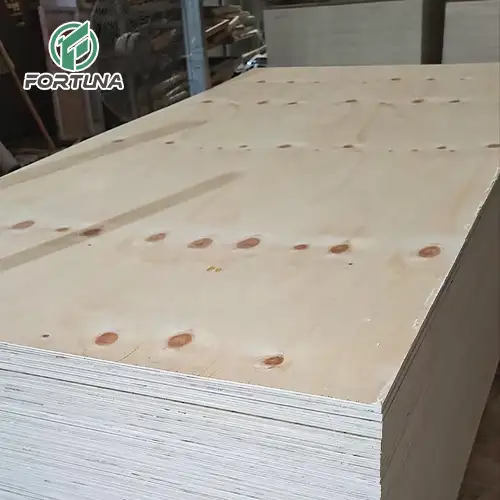
Key CDX Pine Plywood Specifications Buyers Should Check
When buying CDX Pine Plywood wholesale, do not compare suppliers based only on price per sheet.
A procurement specification should cover the following.
1. Face and Back Grade
Confirm whether the panel is genuinely manufactured with the requested C/D veneer configuration.
2. Core Construction
Ask whether the core uses:
- Pine
- Poplar
- Eucalyptus
- Hardwood
- Combi core
Different core constructions can produce different density, stiffness, weight, machining behavior, and price.
3. Thickness
Common construction specifications vary by market and application.
Fortuna Wood’s current CDX product range lists thicknesses from 6 mm to 30 mm, with 18 mm / 3/4-inch listed as one standard product specification.
However, the correct thickness should always be determined by the project’s engineering requirements rather than simply choosing the most common size.
4. Panel Dimensions
Fortuna currently lists 1220 × 2440 mm and 1250 × 2500 mm, with customized dimensions available according to its product information.
For international buyers, dimensions should also be matched with container loading requirements.
5. Adhesive
Ask precisely what adhesive is being used.
Fortuna’s current CDX product information lists options including phenolic, WBP melamine, MR, E0, E1 and E2, depending on specification.
Do not assume that two products called “CDX plywood” have identical moisture or emission performance.
What Is CDX Pine Plywood Used For?
The strongest commercial opportunity for CDX Pine Plywood is in applications where structural function matters more than appearance.
Common applications include:
- Roof sheathing
- Wall sheathing
- Subflooring
- Construction panels
- Exterior wall systems
- Packaging
- Joinery
- Temporary construction applications
Fortuna’s product information specifically lists construction, packaging, sub-flooring, roofing, wall exterior and structural applications.
APA likewise identifies plywood applications including subflooring, wall and roof sheathing, structural insulated panels, concrete forming, industrial containers and other demanding uses.
CDX Pine Plywood vs Other Plywood
| Factor | CDX Pine Plywood | Furniture Plywood | Marine Plywood | Film Faced Plywood |
|---|---|---|---|---|
| Main Purpose | Structural construction | Furniture/interior | Marine & wet applications | Concrete formwork |
| Appearance | Utility grade | Higher appearance | Higher-grade faces | Film-coated |
| Structural Use | Yes, when appropriately rated | Depends on grade | Yes | Mainly formwork |
| Surface | Natural veneer | Sanded/decorative | Natural veneer | Phenolic film |
| Concrete Formwork | Not its primary purpose | Generally unsuitable | Not economical | Excellent |
| Long-Term Weather Exposure | Depends on rating | Depends on rating | Designed for demanding wet use | Designed for formwork exposure |
| Cost Position | Competitive | Higher | Higher | Application dependent |
The key point is simple:
There is no universally “best” plywood. The right panel depends on the engineering requirement and exposure conditions.
Is CDX Pine Plywood Waterproof?
No—not simply because it is called CDX.
This is one of the most important points for buyers.
Exposure 1 plywood is designed to tolerate moisture exposure during construction, but APA specifically warns that it should not be confused with Exterior-rated plywood for long-term weather exposure.
If your project requires permanent exposure to rain, snow, or other weather conditions, the purchasing specification should require the appropriate Exterior-rated structural panel, rather than relying on the word “CDX.”
This is also why buyers should ask suppliers for the applicable test reports and product documentation before signing a large purchase order.
How to Choose CDX Pine Plywood for a Project
Before placing a bulk order, answer these seven questions:
1. Where will the plywood be installed?
Roof, wall, floor, packaging, temporary construction, or another application?
2. Will it experience moisture?
Temporary construction exposure and permanent weather exposure are different requirements.
3. What structural performance is required?
The engineer’s specification should determine thickness, grade and rating.
4. What dimensions does the project require?
Standard 4 × 8-foot-style panels may not always be the most efficient option for your project or container.
5. What core construction is acceptable?
Core composition can have a significant effect on performance and price.
6. Which market standards apply?
A North American project may have different documentation requirements from a European or Middle Eastern project.
7. What documentation will the supplier provide?
For large-volume procurement, request product specifications, test reports, certification documents and pre-shipment inspection arrangements where appropriate.
What Should Global Importers Ask a CDX Plywood Supplier?
If you are a wholesaler, distributor, or project buyer, ask your supplier for a written specification rather than relying on a product name.
A useful RFQ should include:
- Product name
- Face/back grade
- Core material
- Thickness
- Length and width
- Glue type
- Emission requirements
- Structural requirements
- Exposure classification
- Edge treatment
- Surface treatment
- Packaging
- Loading quantity
- Required certificates
- Inspection requirements
- Delivery terms
This makes supplier quotations much easier to compare.
It also prevents a common sourcing problem: comparing two products with the same commercial name but different technical specifications.
Why Source CDX Pine Plywood from China?
China has a mature engineered-wood manufacturing supply chain, particularly in Shandong and other major wood-panel production regions.
For international B2B buyers, the potential advantages include:
- Large production capacity
- Multiple core options
- Customized dimensions
- OEM production
- Competitive manufacturing costs
- Export packaging
- Container-scale procurement
Fortuna Wood states that its business serves global importers, furniture factories, construction companies and building-material wholesalers, with markets including North America, Europe, Latin America, Southeast Asia, the Middle East and Africa.
CDX Pine Plywood from Fortuna Wood
Fortuna Wood’s CDX Pine Plywood product page
Fortuna Wood currently lists CDX Pine Plywood with pine or spruce face options, multiple core materials, customized sizes, and thicknesses from 6 mm to 30 mm. Its listed applications include construction, packaging, sub-flooring, roofing, wall exterior and structural use.
The company also lists FSC and CE certification options on the product page and provides additional specifications for glue, density, moisture content and surface treatment. Buyers should confirm the exact certification and specification applicable to the specific order before purchasing.
For a project requiring a particular structural standard, the most important step is to send the supplier the complete technical specification, not just the words “CDX Pine Plywood.”
FAQs
1. What does CDX stand for in plywood?
CDX commonly refers to a plywood panel with a C-grade face, D-grade back and an Exposure 1-type bond classification in U.S. trade terminology. APA notes that “CDX” is a common trade term rather than the preferred complete specification for structural plywood.
2. Is CDX Pine Plywood structural plywood?
It can be used as structural plywood when the specific panel meets the applicable structural requirements and is properly specified. The term CDX alone does not establish every structural performance characteristic.
3. Is CDX plywood suitable for roofing?
CDX-type structural sheathing is commonly associated with roof sheathing, but the exact panel rating, span rating, thickness and exposure classification must match the project requirements.
4. Can CDX plywood be used outdoors?
Exposure 1 CDX should not automatically be treated as suitable for long-term outdoor exposure. APA recommends Exterior-rated panels for long-term weather exposure.
5. What is the difference between CDX and plywood?
CDX is a particular trade designation describing veneer grades and exposure classification. “Plywood” is the broader product category and includes many different grades, constructions and applications.
6. Is CDX Pine Plywood good for subflooring?
For reusable formwork, choose Film Faced Plywood. For permanent moisture exposure, choose Marine Plywood.
7. What thickness of CDX plywood should I buy?
There is no single thickness that fits every project. The correct thickness depends on span, loading, framing spacing, structural design and applicable building requirements.
8. What should I ask a China CDX Plywood Supplier?
Ask for a complete product specification covering face/back grade, core, thickness, dimensions, adhesive, exposure classification, structural rating, certifications, test reports, packaging and inspection requirements.
Final Verdict: Is CDX Pine Plywood Right for Your Project?
CDX Pine Plywood is a practical construction panel when the project requires functional structural performance rather than a premium decorative surface.
Its C/D veneer grading makes it well suited to applications where appearance is secondary, while the relevant exposure classification determines how the panel should be used around moisture.
For international buyers, the most important lesson is this:
Do not buy plywood based on “CDX” alone. Buy against a complete technical specification.
For contractors, wholesalers and importers, that approach makes supplier comparisons clearer, reduces specification misunderstandings and helps ensure the plywood ordered is appropriate for the actual project.
If you are sourcing CDX Pine Plywood, Structural Plywood or Construction Panels in container quantities, provide your required dimensions, thickness, core, glue, exposure classification, standards and destination market before requesting a quotation.